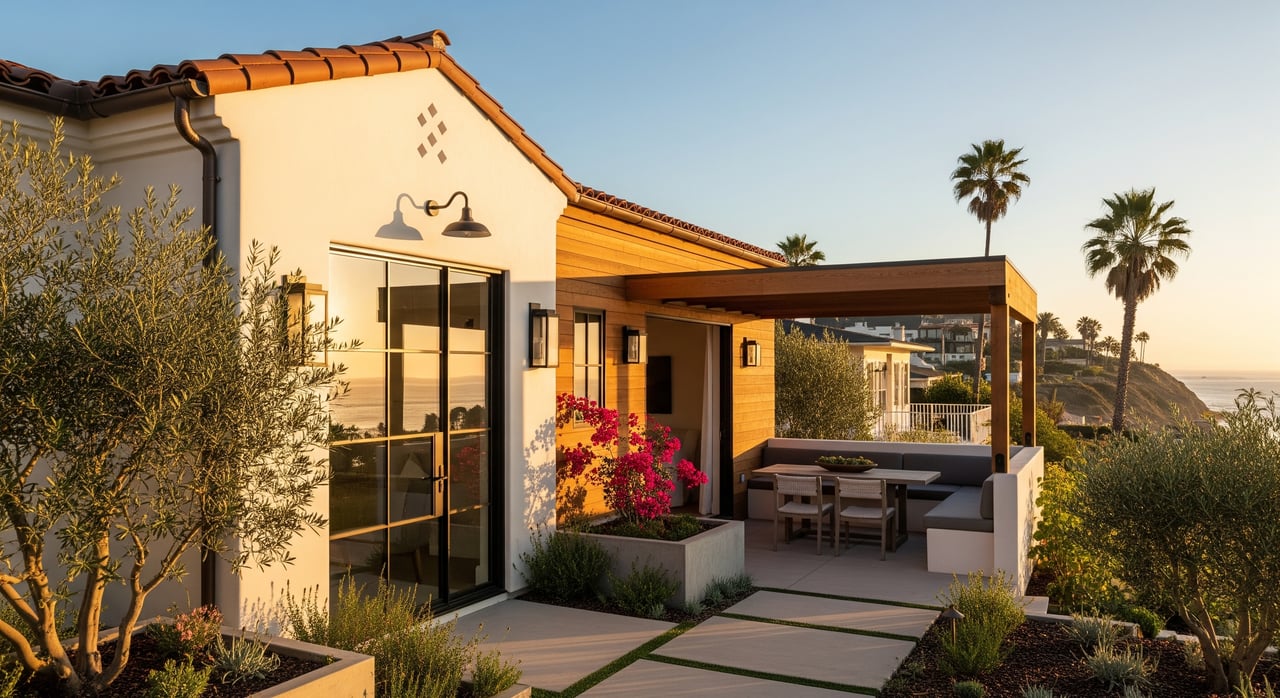
Thinking about turning your San Clemente backyard into steady rental income? You are not alone. With California’s strong ADU laws and high coastal demand for quality rentals, adding an accessory dwelling unit can be a smart play. In this guide, you will learn what the rules allow, how permits work, parking and setback basics, timelines, costs to consider, and a simple way to model your return. Let’s dive in.
ADU basics in San Clemente
An accessory dwelling unit is a small, independent home on the same lot as your primary residence. In San Clemente, owners commonly create ADUs in a few ways:
- Detached ADU as a new, separate structure
- Attached ADU added onto the main home
- Conversion ADU by repurposing an existing garage, attic, basement, or accessory structure
- Junior ADU (JADU) created within the primary home, typically with a smaller footprint
Each type follows state rules and local objective standards. Your lot, utilities, and site conditions will help determine which option is the best fit.
What California law guarantees
California’s ADU statutes set the baseline that cities, including San Clemente, must follow. Here are the key protections for you:
- Ministerial approvals. If your ADU meets objective standards, the city must process your application without discretionary hearings. This reduces uncertainty and keeps approvals focused on clear checklists.
- Timely decisions. There is a statutory clock for decisions on complete ADU applications. Cities aim to turn compliant submittals around quickly.
- Limited fees. Impact and connection fees are limited, especially for smaller ADUs. Larger ADUs may pay proportionate fees, not full new-unit rates.
- Parking limits. Cities cannot require more than one space per ADU. Parking can be waived entirely in specific circumstances, such as proximity to transit or when converting existing space.
- Owner-occupancy. State law limits how and when cities can impose owner-occupancy rules. Check current requirements as policies evolve.
Bottom line: state law gives you a strong pathway to approval, and local rules must align with those protections.
What San Clemente reviews and approves
San Clemente’s Planning and Building divisions will apply objective standards to your project. Expect reviews to focus on things like height, setbacks, lot coverage, fire and life safety, and utility capacity. Numeric thresholds vary by jurisdiction and change over time, so confirm the latest standards directly with city staff before you design plans.
Common items to confirm with the city:
- Maximum size for detached and attached ADUs
- Height limits and any upper-story design requirements
- Side and rear setbacks, plus lot coverage and open-space rules
- Fire-safety needs, including sprinklers where applicable
- Objective design standards such as entries, windows, and privacy
Step-by-step permitting roadmap
Here is a straightforward path many San Clemente owners follow:
- Early consultation. Speak with Planning to confirm your lot’s zoning, setbacks, and basic feasibility. Ask Building about plan-check submittals and fees.
- Site-fit design. Work with an ADU-savvy architect or designer to align your layout with objective standards and utility access.
- Submittal package. Prepare a complete application with site plan, floor plans, elevations, and utility notes. Many owners submit Planning and Building permits together.
- Plan check. Respond quickly to any correction comments. Ministerial ADU reviews focus on objective compliance, not subjective design opinions.
- Permit issuance. Pay permit fees when cleared to issue. Confirm utility connection steps and meter decisions before breaking ground.
- Construction and inspections. Schedule inspections as you progress. Keep your contractor, designer, and city inspector in sync.
Timelines you can expect
Timelines vary with city workload and project complexity, but these ranges are common:
- Planning review of a complete package: weeks to a couple of months, often 30 to 60 days
- Building plan-check cycles: 2 to 8 weeks per cycle depending on corrections
- Construction: 3 to 9 months for a modest detached ADU or a garage conversion; prefabricated or modular units can be faster after permits
From first consult to move-in, many projects land in the 6 to 18 month range. Your schedule will depend on design complexity, contractor availability, and utility coordination.
Parking and setback essentials
Parking
- Requirement limits. Cities cannot require more than one off-street space per ADU.
- When parking may be waived. If your ADU is within a half-mile of public transit, part of an existing structure, or in certain other scenarios, parking may not be required. Confirm the details with Planning.
Setbacks and height
- Reduced setbacks. Many California cities allow reduced side and rear setbacks for ADUs compared with standard accessory structures. In some jurisdictions, that reduction can be as little as a few feet. Verify San Clemente’s exact numbers before you finalize plans.
- Height standards. Detached ADUs commonly face objective height limits, which vary by city and can depend on whether the unit is one or two stories. Ask for the current local standard.
Tip: If your lot is constrained or on a slope, explore a conversion ADU or a compact detached design that fits within the most flexible setback zones.
Fees, utilities, and connections
Plan-check and permit fees apply based on the project’s scope and valuation. For many smaller ADUs, impact and connection fees are limited by state law. Larger ADUs may pay a proportional share rather than the full fee assessed to a new single-family home.
Utility planning is critical. Early in design, clarify:
- Sewer and water capacity and connection points
- Whether you will install separate or shared meters for gas and electric
- Trenching paths, driveway cuts, or site work needed to reach utilities
These line items can shift budgets. Build in contingency reserves for site surprises, especially on older or hillside lots.
Fire, safety, HOAs, and short-term rentals
Fire and safety
- In parts of Orange County, wildland-urban interface conditions and local fire code can trigger standards such as ember-resistant construction or defensible space.
- Fire sprinklers may be required depending on project specifics. Confirm early with the Fire Department and Building.
HOAs and CC&Rs
- State law limits some HOA restrictions on ADUs, but many communities still require architectural review and impose objective design guidelines. Review your CC&Rs and engage the board in the early design phase.
Short-term rentals
- ADUs are subject to local short-term rental rules. If you are considering vacation or monthly rentals, confirm the city’s current ordinance and any HOA limits before you build.
How to estimate rent and ROI
Start with realistic rent comps
- Pull comparable ADU, studio, and one-bedroom rents in San Clemente and nearby South Orange County cities.
- Adjust for unit type and finishes. A well-finished detached ADU with a private entry and full kitchen typically commands higher rent than a compact conversion or JADU.
- Note coastal factors. Proximity to the beach, transit access, and walkability can influence rent.
Build a simple income model
- Gross rent: market monthly rent × 12
- Vacancy: set 5 to 7 percent for long-term leases
- Operating costs: property management, repairs, insurance, utilities you cover, and reserve funds
- Debt service: include your construction loan or cash-out refinance terms
Key metrics
- Net Operating Income (NOI) = Effective gross income − operating expenses
- Cash Flow (before taxes) = NOI − annual debt service
- Cap Rate = NOI ÷ total project cost
- Cash-on-Cash Return = Annual pre-tax cash flow ÷ cash invested
- Payback Period = Initial cash invested ÷ annual pre-tax cash flow
Illustrative example
- Size and rent. A 500 sq ft ADU rents for $2,200 per month. Gross annual rent equals $26,400.
- Vacancy. At 6 percent vacancy, effective gross income is $24,816.
- Expenses. If operating expenses run about 30 percent, NOI is roughly $17,371.
- Financing. Suppose total build cost is $200,000, financed at 75 percent loan-to-value at 5 percent interest. Annual debt service could land near $9,000 to $11,000 depending on term.
- Result. Cash flow may fall in the $6,000 to $8,000 range. Cash-on-cash depends on the cash you invest up front.
Use this as a framework. Your actual outcome will depend on rent comps, exact build and connection costs, and your financing.
Cost drivers to watch in Orange County
- Size and layout. Larger units, more baths, and higher-end kitchens cost more.
- Site conditions. Grading, retaining, hillside work, and tight access add time and money.
- Utility connections. Sewer and water lateral work, panel upgrades, and trenching can swing budgets.
- Code upgrades. Structural retrofits, seismic work, and fire-safety measures may be required.
- Market conditions. Contractor availability and material pricing shift through the year.
Get multiple bids from licensed contractors experienced with ADUs in South Orange County. Ask for references and recent permit histories.
Taxes and assessments
Adding an ADU can increase your assessed value. The Orange County Assessor will evaluate the improvement under California’s assessment rules. Plan for an adjustment to your annual property tax bill based on the value of the new structure rather than a full reassessment of your entire property.
Your ADU action plan
- Confirm feasibility. Speak with San Clemente Planning and Building about current objective standards, fees, and the ministerial process.
- Review CC&Rs. If you have an HOA, review guidelines and begin architectural review early.
- Align the design. Choose the ADU type that best fits your lot and budget. Validate utility routes and meter options.
- Price the project. Obtain at least three detailed contractor bids, including utility and site work.
- Model the numbers. Use rent comps, set realistic vacancy and expenses, and test several financing options.
- Map your timeline. Build in cushion for plan-check cycles and inspections.
How we help you move from idea to income
You do not need to navigate this alone. The coastal markets in Dana Point, San Clemente, and across South Orange County are our home turf. We help you evaluate ADU potential when buying, selling, or improving, and we connect you with vetted local architects, contractors, lenders, and property managers. Our role is to save you time, reduce friction, and keep your numbers grounded in the realities of our market.
Ready to explore your property’s ADU potential or find a home with a buildable lot? Reach out to the Danielle Hesley Real Estate Group for local guidance tailored to your goals.
FAQs
What ADU types can I build in San Clemente?
- You can typically pursue a detached or attached ADU, convert existing space like a garage or attic, or add a smaller Junior ADU within the main home, all subject to objective local standards.
Do I need parking for an ADU in San Clemente?
- Cities cannot require more than one space per ADU, and parking can be waived in specific cases such as proximity to public transit or certain conversions; confirm your site’s conditions with Planning.
How long does it take to get an ADU permit?
- Ministerial ADU reviews run on a statutory decision clock, and many compliant applications clear plan check in weeks to a couple of months, followed by construction that often takes 3 to 9 months.
Can I use my San Clemente ADU for short-term rentals?
- ADUs must follow San Clemente’s short-term rental rules and any HOA limits; verify current regulations before you design your unit around vacation rental income.
How much does an ADU cost to build in Orange County?
- Costs vary widely with size, site work, and finishes; expect a broad range from the low hundreds to several hundreds of dollars per square foot, plus permits and utility connections.
Will my property taxes increase after I add an ADU?
- Yes, the Orange County Assessor typically adds the value of the new ADU to your assessment while keeping your base property value protections in place under California rules.
Do HOAs in San Clemente allow ADUs?
- State law limits blanket bans, but many HOAs require architectural review and objective design compliance; review CC&Rs and engage the board early in your process.